Why Late Spring and Early Summer Are Volcano Season in the Pacific Northwest
Volcano season in the Pacific Northwest doesn’t really announce itself.
It just starts happening.
One week you’re still looking up at these peaks from town, wondering if they’re even in condition yet. The next, you’re pulling into trailheads before sunrise and there are already a few cars there, headlamps moving around in the dark like everyone is trying not to wake the day up too fast.
No one is rushing. It’s too early for that. But everything feels deliberate.
Skins get sorted while coffee gets passed around in half-drunk sips, steam mixing with cold air that hasn’t decided to wake up yet. Everything feels a little stiff at first, like it needs a few more minutes before it really starts working.
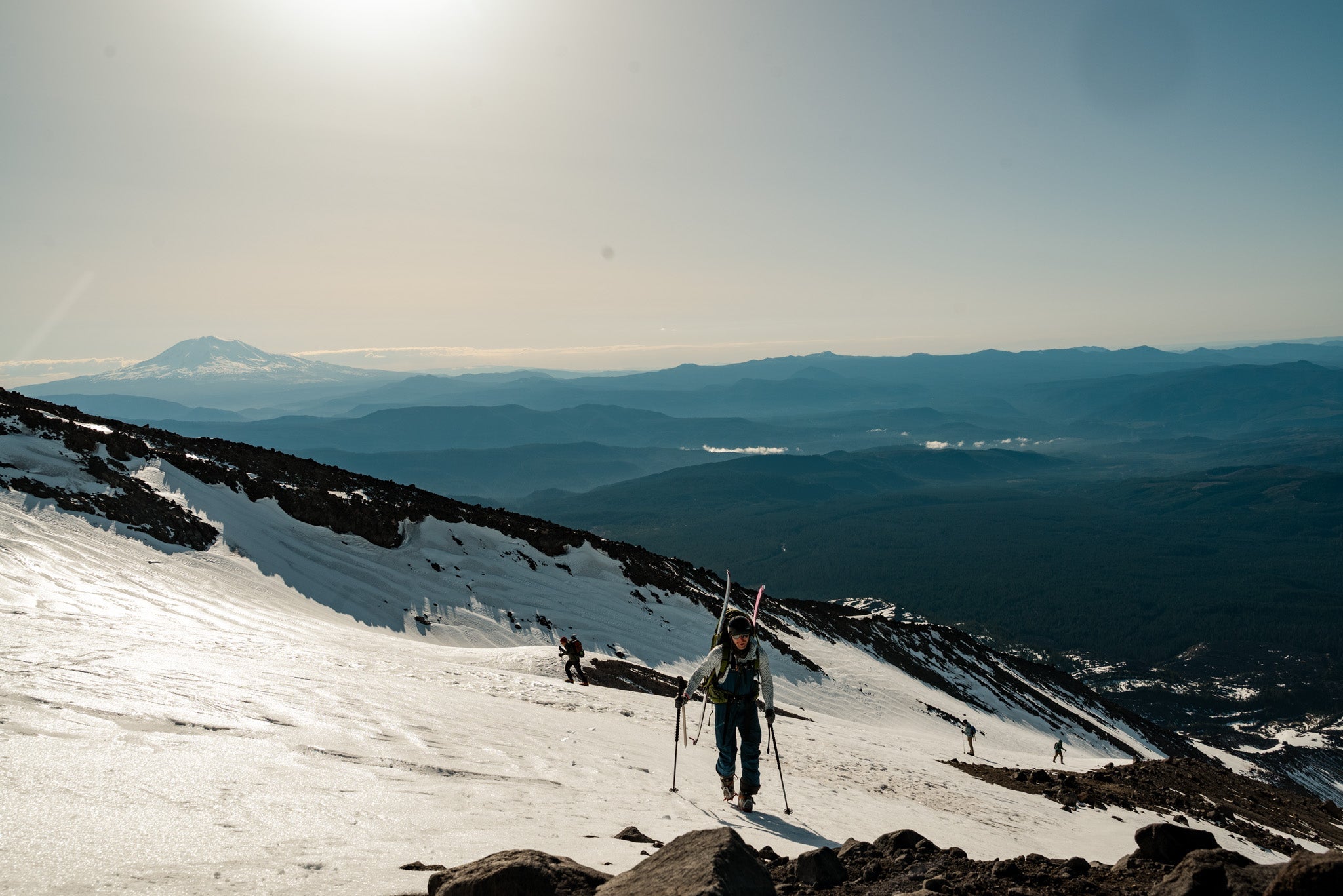
Then you start climbing.
And that’s it.

The window shows up in small ways first
Late spring in the Cascades is really just a timing shift in disguise.
Snowpack settles out. Storm cycles start spacing themselves apart. Nights still lock things up, but not in the unpredictable way mid-winter does. And then the sun angle changes enough that everything starts moving on a schedule again.
Not all at once. Just enough that you notice it if you’ve been watching the same mountains all winter.
Hood. Adams. St. Helens. Rainier. Baker.
Same line of peaks you’ve been staring at from town for months. Suddenly they’re all “in.”
And you feel it pretty quickly once you’re on them. Skin track holds. Transitions are simple. Nobody is digging around in their pack more than they need to. It just goes uphill the way it’s supposed to.
At least for a while.

Morning always feels easier than it should
Early on, it almost tricks you.
Snow is firm. Edges feel solid. Skins glide without much thought. You can move at a steady pace and it feels like the whole day might just be like this.
That’s usually where people relax a bit too early.
Because the mountain hasn’t warmed up yet.
As the sun starts working its way into the system, everything begins to separate. Lower down, snow softens fast. Mid-mountain turns inconsistent. Higher up stays cold but starts catching wind.
It doesn’t shift in a clean line. It’s more like stepping through different versions of the same day as you climb higher.
You start noticing it in small ways first.
Stopping a little more often. Adjusting layers. Taking gloves off and putting them back on for no real reason other than things not lining up anymore.

Where things actually start to break down
It’s rarely the climb that gets people.
It’s everything happening between the movements.
Overdressing early is probably the most common thing you see. People start cold and solve it too aggressively, then spend the rest of the climb trying to manage heat they didn’t need to trap in the first place.
Or the opposite. Under-layering and trying to push through, then stopping more often than they should because they’re trying to fix it mid-route.
Either way, the flow of the uphill gets interrupted.
And once that happens, it stacks.
A longer stop here. A slower transition there. Fumbling with a zipper that should be simple. None of it feels like much on its own, but over a few thousand feet it starts to matter.
Fitness is almost never the limiter on these days.
It’s how often you have to stop doing what you were already doing.

Gear doesn’t matter more. It just matters differently.
Volcano days strip things down pretty quickly.
You learn what actually stays on your body while you’re moving and what just rides in your pack the whole time.
Breathable layers end up doing most of the work on the climb. Not insulation for standing around, but pieces that can handle steady output without turning into a heat trap. Softshells usually end up staying on longer than anything else.
Active insulation fits in here too, especially on those in-between sections where you’re working hard but still getting hit with wind or short breaks in exposure.
Then you crest the summit ridge and it all flips.
Wind shows up. Temperature drops. You’re suddenly not trying to stay cool anymore, you’re trying not to lose heat too fast.
Same day. Different problem.
What matters is how little you have to think about any of it while it’s changing.
Things that come on and off without slowing you down. Layers you don’t have to reorganize your whole pack to access. Nothing clever. Just dependable when conditions aren’t.

Each volcano has its own version of the same day
The pattern is shared. The details aren’t.
Mount Hood is the most accessible and often the most crowded. Timing matters because everyone is trying to hit the same window, forming the infamous conga line up the South side summit route. The margin between a good descent and a heavy one can be narrow.
Mount Adams feels like it expands the longer you’re on it. The approach alone takes time, and once you’re climbing it just keeps going. No real breaks in character. Just steady effort upward through terrain that never quite feels as steep as it should. The descent is where it comes alive though, once conditions line up and you’re looking at thousands of feet of continuous fall line skiing.
Mount Rainier changes everything as soon as you step onto it. You’re in glaciated terrain immediately, whether conditions feel friendly or not. Crevasses, rope systems, route decisions. Even on a good day it carries weight. You move differently because you have to.
Mount Baker is the one that keeps you guessing. Morning can feel clean and obvious, almost straightforward. By afternoon, maritime weather starts rewriting the plan. What looked like a predictable descent can turn into something entirely different depending on when you’re standing on it.
Mount St. Helens is where most people first get a taste of volcano travel in the Cascades. More approachable than the others, but still big enough that it doesn’t feel casual once you’re on it. The upper mountain opens up in a way that makes you pay attention to wind more than you expected.

What a good volcano day actually feels like
The best days are almost forgettable while they’re happening.
You just move. No real interruptions. No standing around fixing things that should have been sorted earlier. Transitions stay simple enough that you stop noticing them.
It doesn’t feel fast. It just doesn’t feel interrupted.
Bad days are the opposite. You notice everything. Every stop takes longer than it should. Every adjustment turns into a small reset. By the time conditions actually get good, you’re already working against fatigue.
Nothing dramatic. Just a steady loss of efficiency you only really see in hindsight.

Why people keep coming back
Volcano season is repetitive in a way that doesn’t get old.
Same early mornings. Same frozen gear. Same quiet start in the dark before anything softens.
But the mountains never give you the same day twice. Conditions shift just enough that you can’t rely on what worked last weekend, even on the same route.
So you stay engaged with it.
And when it goes right, it’s simple in a way that feels almost obvious.
Move early. Don’t overcomplicate the system. Adjust when you need to, not because you can.
Then ski the infamous PNW top shelf corn before it turns to mashed potatoes.
Pack up. Drive out. Start thinking about the next one.